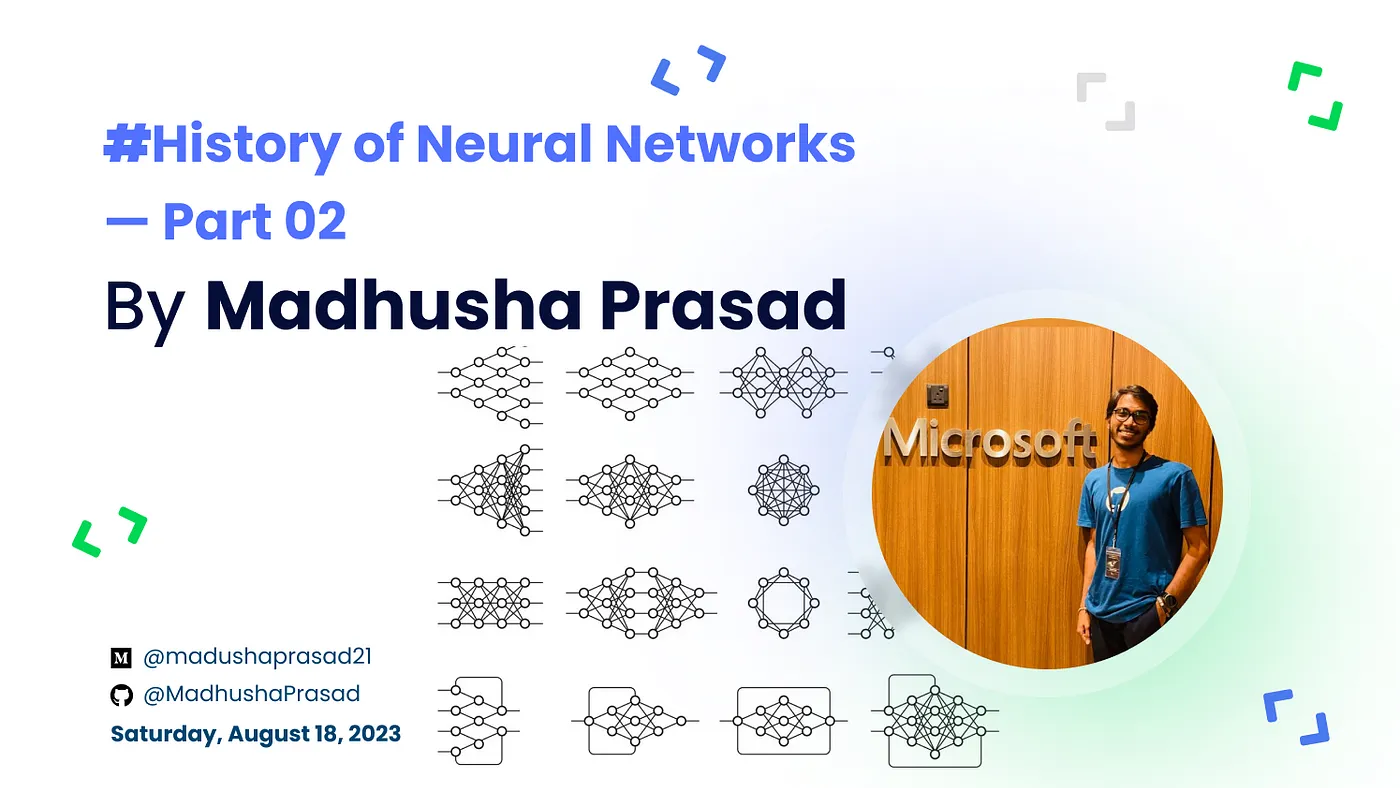
History of Neural Networks — Part 02
In this article, I will continue the previous article, History of Neural Networks — Part 01, Then let's talk about the History of Neural Networks from The 1980’s to the present.

I’m a passionate Full Stack Software Engineer from Sri Lanka, driven by a love for creating innovative solutions and crafting seamless digital experiences. As an avid open-source enthusiast and maintainer, I have gained invaluable insights and skills from the vibrant open-source community. I am constantly inspired by how collaboration and knowledge sharing bring people together to solve complex challenges and build impactful projects. My journey has been shaped by a commitment to continuous learning, contributing to meaningful initiatives, and leveraging technology to make a difference.






In this article, I will continue the previous article, History of Neural Networks — Part 01, Then let's talk about the History of Neural Networks from The 1980’s to the present.
In 1943, A study proposing a possible mechanism by which neurons function was co-authored by neurophysiologist Warren McCulloch and mathematician Walter Pitts. They constructed a basic neural network with electrical circuits to try to explain how neurons in the brain could function.

When I wrote my first React component, I treated it like 'just another front-end library.' Years later, after building production apps in React, Vue, Angular, Laravel, Flutter, and more, I've come to see React as an ecosystem where discipline matters more than syntax.In this article, I'll walk through the React best practices every developer has to follow, not as theory, but as patterns I've learned (sometimes the hard way) while shipping real products: from e‑commerce and admin panels to mobile apps and notification libraries.
Micro-frontends extend the microservices approach to the frontend world, allowing large teams to work independently on different features of a web application. This modular approach helps organizations scale their development process, improve code maintainability, and enable technology diversity across teams.